Seasonal Geography: Why the UK’s Daylight Hours Change So Much
Book a cottage in Cornwall for the second week of June and you can eat outside at nine in the evening, still in daylight. Book the same cottage for the second week of December and you will be reaching for the light switch at half past four. Nothing about the sun has changed. What has changed is the angle at which Britain meets the light — and once you understand that angle, planning a trip around UK daylight stops being guesswork.
A Tilted Planet, Not a Distant Sun
The Earth spins on an axis that leans roughly 23.4 degrees away from perpendicular to its orbit. That lean keeps pointing the same way in space as we travel around the sun, so for half the year the northern hemisphere tilts sunward and for half of it tilts away.
It is tempting to assume long days mean we are closer to the sun. In fact Earth reaches its closest point to the sun in early January, the depth of the northern winter. Distance is not the driver; angle is. When the northern hemisphere leans towards the sun, light arrives more directly, covers less ground and stays above the horizon longer. When it leans away, the light comes in at a slant, spreads thinner across the surface, and the days contract.
Latitude Turns the Tilt Into Hours
The UK spans roughly 50°N at the Lizard to just past 60°N in Shetland. That is a modest stretch on a map, but daylight responds sharply to latitude. London's longest day gives around 16 hours 40 minutes of daylight; its shortest gives under eight. In Lerwick, midsummer stretches to roughly 19 hours and midwinter offers fewer than six. Same country, same tilt, very different days.
Two things follow for anyone planning a trip. First, the further north you go, the more seasonal the place becomes. A week in the Highlands in June buys a far longer usable evening than the same week in Dorset. Second, the extremes are extreme: at midsummer in Shetland the sun barely leaves the sky, and even after it sets there is enough lingering light to walk or read a map outdoors. At midwinter the same islands see a low, brief burst of daylight and little else.
Solstices, Equinoxes and the Pace of Change
The year turns on four markers: the summer solstice around 21 June, the winter solstice around 21 December, and the equinoxes in late March and late September, when day and night are roughly equal almost everywhere.
The speed of change matters as much as the totals. Around the equinoxes, the UK gains or loses daylight fastest — several minutes a day, more in the north. Around the solstices, the change all but stops, which is why late December feels frozen and then, by the end of January, an extra hour has quietly appeared in the afternoons. If you are booking for the shoulder months, remember that shifting a trip by a week in late March or mid-September can move sunset by a quarter of an hour or more.
Clocks Add a Second Twist
British Summer Time runs from the last Sunday in March to the last Sunday in October, and it shifts everything by an hour. That is why sunset tables are useless unless you know which time zone they are printed in — a spring or autumn booking made without checking can put you on a hillside an hour after the light has gone.
Longitude has an effect too. The UK runs on a single time zone despite spanning several degrees of longitude, so the far west of Cornwall, Wales, Scotland and Northern Ireland sees the same solar events later on the clock than East Anglia. In midsummer, sunset in the west can fall a good three-quarters of an hour after the east coast's. Solar noon in summer sits closer to 1pm than to midday. Ferries, flights, tide tables and attraction opening times are generally published in local time, so read the small print rather than assuming.
What the Light Does to a Trip
- Photography. Golden hour is longest near the solstices, and in the north in June it can run well past ten at night. Sunrises are usually quieter than sunsets, and the light is often softer.
- Long walks and cycles. In June you can plan a full hill day and still finish in daylight. In December, a six-hour route needs an early start, and a head torch belongs in the pack.
- Driving. Rural lanes, single-track roads and Highland routes are far better driven in daylight. Between November and February, treat 4pm as the end of the useful outdoor day.
- Opening hours. Castles, gardens and museums tend to close long before sunset in summer. Use the long evenings for coast paths, beaches and wandering instead.
- Dark skies. Auroras and star-gazing need real darkness, which in most of the UK means roughly September to March. Midsummer trips north will not deliver it.
- Dusk insects. In the Highlands and islands, the hours around dawn and dusk are often the busiest for biting midges — exactly when photographers want to be out. A head net weighs almost nothing.
Planning Your Days Around the Light
- Check sunrise and sunset for the exact date and the exact place, not just for London. Coastal and island locations differ noticeably from inland ones.
- Work backwards from the light rather than forwards from breakfast. Decide whether you want golden hour, blue hour or broad daylight, then set the day around it.
- Arrive early. Give yourself half an hour before sunset to park, walk in and settle. The best viewpoints fill up quickly in summer.
- Plan indoor time for winter afternoons. A museum, a long lunch or a train journey makes a short December day feel generous rather than truncated.
- Carry a small torch, something reflective and a charged phone if you are walking lanes after dark in the darker half of the year.
- Mark the two clock-change weekends in your diary. Bookings, timetables and your own body clock all lag behind for a day or two.
Get the light right and the rest of an itinerary tends to settle into place. Britain's long summer evenings are among the best free things about travelling here, and its short winter days are a decent excuse to slow down, book the museum and take the long lunch. Both are written into the planet's tilt, and both can be planned for.
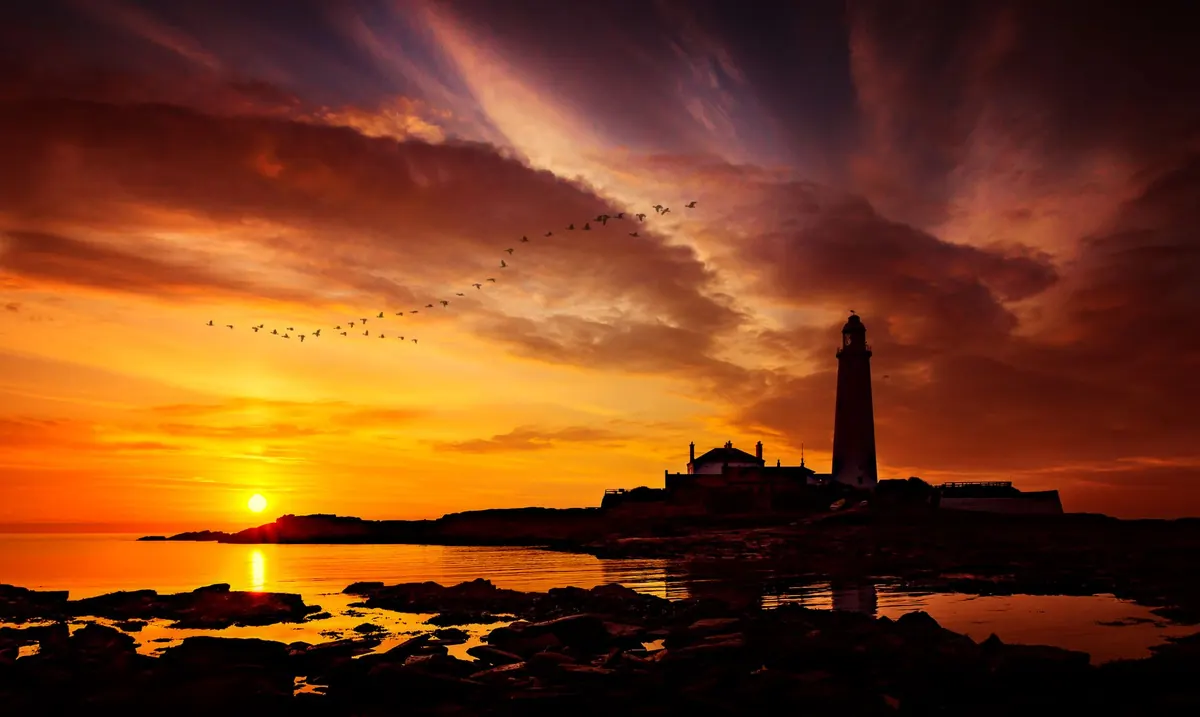
Photo: Ray Bilcliff / Pexels